Last week I gave a workshop for new Executive Directors of arts organizations in North Carolina at the invitation of the North Carolina Arts Council and Triangle Art Works. The group had a wide range of professional experience inside and outside of the arts, so I strove to make the workshop useful to all of them.
This week on my website I’ll share what I talked about with them, and hopefully you’ll find it useful, too. The goal is to help arts leaders gain clarity, confidence, and practical tools to lead effectively without burning out. Drawing on my own experience as a former Managing Director and Executive Director of nonprofit theaters and current educator in arts management, each post breaks down one of four key ideas:
- The Executive Director role is complex—but manageable with a framework.
- Prioritizing well creates space for strategic thinking.
- Sharing leadership strengthens your organization and your experience.
- Building partnerships is about trust, not pitching.
And then on Friday, I’ll share why I think it’s OK to “do less with less” rather than “do more with less” as we have in the past.
OK, let’s jump into the first part today.
What IS my job anyway?
When I started my first senior leadership position, I often found myself thinking, Is this what the job is supposed to feel like? One minute I was reviewing contracts, then writing a grant, and then troubleshooting an urgent issue —all before lunch. It could feel just like a catch all job, like I was someone who had been endowed with some authority to make decisions so everyone else could get on with their work.
I had to step back and make sense of what I was doing so I was actually leading, rather than just responding to the people were popping into my office nonstop.
The ED Role: Generalist by Design
Here’s one big part that makes being an ED tricky: it’s a generalist’s job. You’re expected to understand enough about everything to lead across the whole organization. If you have staff, you need to supervise them effectively. If you don’t have staff, you’re doing the work of multiple specialists at once. (In other words, you’re a generalist.) Either way, you’re spinning a lot of plates.
In theory, there are plenty of excellent frameworks out there to help clarify the role—BoardSource’s ten responsibilities of an Executive Director, John Kotter’s work on leadership vs. management, and the Balanced Scorecard are all useful. I find that ten categories were too many, and two were too few. I needed something I could hold in my head in the middle of a hectic day and use to reflect at the end of the day so I could achieve some sense of closure and be present for the rest of my life.
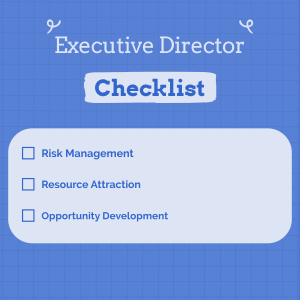
Here’s a simple framework I shared in the ArtsCore workshop. It breaks the ED role into three core buckets: Risk Management, Resource Attraction, and Opportunity Development.
The Three Buckets of ED Responsibility
#1 Risk Management
Don’t let the ship sink—today or tomorrow.
At its most basic, this is what your board, community, and staff expect from you: that the organization is safe, stable, and functioning.
This includes responsibilities like:
- Keeping your building safe
- Preventing financial fraud
- Maintaining solid HR and volunteer practices
- Using contracts and written agreements
These things may not get a lot of applause, but they’re what keep the mission protected. They’re the floor beneath everything else.
#2 Resource Attraction
Bring in what your organization needs to do its work—now and in the future.
We often think of this as fundraising, and it is. But it’s also:
- Attracting and retaining talented staff and volunteers
- Securing adequate space for your organization to do its programs
- Building goodwill in the community
- Cultivating relationships with city officials, donors, and collaborators
This bucket lives in both the short-term and the long-term. It’s about solving for today and planting seeds for tomorrow.
#3 Opportunity Development
Look up from the day-to-day and shape what comes next.
This is the part of the job that’s easy to lose sight of when things are busy—but it’s what moves your organization forward. It looks like:
- Talking to audience members or program participants to learn what’s resonating
- Keeping track of artists whose work aligns with your mission
- Paying attention to local politics, development, and cultural trends
Opportunity development requires curiosity and time—and it often doesn’t feel urgent. But it’s where innovation and growth come from.
Why This Framework Helps
Using this framework doesn’t mean you aren’t still doing a wide range of tasks, but it can help make the job feel more strategic and less like just a long to-do list. You can look at your week or month and ask:
- Am I covering all three areas?
- Am I too deep in the weeds of one and ignoring the others?
- Is this something I need to handle, or could someone else own it?
Further, having an organizing concept like this can help you be proactive and take control over your job, and not let others’ needs drive your work. You’re a leader, after all. You’re supposed to be the one that stewards the vision for the organization and sets it direction. Having a framework like this also helps you to communicate your role to my board and staff and advocate for yourself. And honestly, it can help you breathe and find boundaries between work and life.
Looking Ahead
In the next post, I’ll share a simple tool that helped me sort through the nonstop swirl of tasks—what to do, what to delegate, and what to just let go of. It pairs perfectly with this framework and changed the way I work.
I’m grateful to the North Carolina Arts Council and Triangle Art Works for making the ArtsCore program possible—and for the invitation to share this work with a new generation of arts leaders.
Discover more from Hannah Grannemann
Subscribe to get the latest posts sent to your email.
 Hannah Grannemann
[…] not alone in that. This is the second post in a series adapted from a workshop I gave for ArtsCore, a program of the North Carolina Arts Council and […]
LikeLike
[…] Arts Council and Triangle Art Works supporting new Executive Directors across the state. In the first post, I introduced my three-bucket framework (Risk Management, Resource Attraction, and Opportunity […]
LikeLike
[…] The three-bucket framework to understand your role as an ED […]
LikeLike
[…] Understanding your role (Part 1) […]
LikeLike