If you’re an Executive Director, you know the feeling: it’s 9 a.m. and your inbox is already overflowing, your to-do list is longer than your grocery list, and everything feels like it needed to be done yesterday. Urgency seems to be the default setting for arts leadership.
You’re not alone in that. This is the second post in a series adapted from a workshop I gave for ArtsCore, a program of the North Carolina Arts Council and Triangle Art Works supporting new Executive Directors across the state.
In the first post, I shared my three-bucket framework—Risk Management, Resource Attraction, and Opportunity Development—that helped me make sense of the ED role. Now, let’s talk about how to make decisions when everything feels urgent—and why resisting the urge to do it all right now might just save your sanity.
The Pressure to Do It All
As a new ED, it’s easy to get caught in the trap of thinking that your value is measured by how many things you personally tackle each day. I used to wear that mindset like a badge of honor—until I realized it was unsustainable and left me feeling scattered and burned out.
The truth is, when everything feels urgent, it’s almost impossible to tell what’s actually important. As I wrote about in the first post of this series, I have found that simple tools work best, and that’s where a simple tool—the Eisenhower Matrix—comes in.
A Tool to Help You Prioritize
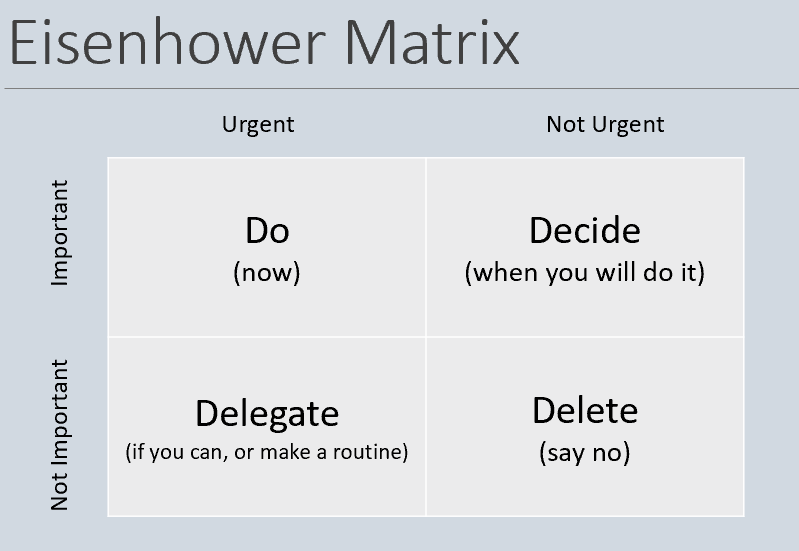
The Eisenhower Matrix is a straightforward way to sort through the chaos. It helps you classify tasks based on two questions:
First, Is it urgent?
Second, Is it important?
Using these questions, you can divide your work into four quadrants:
- Do – Urgent and Important: things that need your attention right now.
- Decide – Important but Not Urgent: things that move your organization forward in the long term.
- Delegate – Urgent but Not Important: things that need to get done, but not necessarily by you.
- Delete – Neither Urgent nor Important: things that clutter your list but don’t add value.
How This Changed My Approach
Here’s how I used the Eisenhower Matrix when I was an ED:
- I gave myself permission to spend time in the Decide box—planning, visioning, and thinking strategically—without feeling guilty that I wasn’t constantly in “firefighting” mode.
- I learned to Delegate more. Trusting others didn’t mean I was less committed; it meant I was leading in a way that empowered my team and expanded the organization’s capacity.
- I got better at spotting what belonged in the Delete box—tasks that were on my list because of perfectionism or habit, not because they really mattered.
Using this tool helped me stop chasing every shiny object and start focusing on what truly mattered for my organization’s mission and future.
Giving Yourself Permission to Slow Down
One of the hardest lessons I learned was that urgency is not the same as importance. If you’re always reacting, you’re not leading. Being able to prioritize helps you:
- Make time for long term, strategic thinking
- Make sure you’re not “dropping the ball” on any part of your job
- Lift you out of endless to-do lists
- Successfully advocate for yourself
- Lead others based on priorities, not the hottest fire
Taking the time to step back, ask the two questions—“Is it urgent?” and “Is it important?”—and sorting your tasks accordingly can be a game-changer. It doesn’t mean you’ll never feel overwhelmed, but it does mean you’ll have a clearer sense of what deserves your focus.
In the next post, we’ll talk about why leadership doesn’t mean doing it all yourself—and how sharing leadership can actually make your organization (and you) stronger.
Grateful, as always, to the North Carolina Arts Council and Triangle Art Works for their support through the ArtsCore program.
Discover more from Hannah Grannemann
Subscribe to get the latest posts sent to your email.
 Hannah Grannemann
[…] The Eisenhower Matrix to sort urgent from important […]
LikeLike
[…] Sorting the urgent from the important (Part 2) […]
LikeLike